
All In on the Fourth Republic: Why Armenia’s Proposed Constitution Has Divided the Nation
As Prime Minister Pashinyan stakes his political survival on a sweeping constitutional overhaul, Armenians weigh the promise of lasting peace against the cost of historical concessions
By Vic Gerami
Prime Minister Nikol Pashinyan’s newly unveiled draft constitution has placed Armenia at one of the most consequential crossroads in its modern history. By removing the preamble’s reference to the 1990 Declaration of Independence, the proposed charter severs the constitutional link to Artsakh (Nagorno-Karabakh) in an effort to satisfy Azerbaijan’s primary precondition for signing a peace treaty. Coupled with Pashinyan’s pledge to step down if voters reject the text in a referendum, the debate has become far more than a technical legal revision. It is a profound reckoning over how a small nation survives amid a deeply asymmetric geopolitical order, and whether lasting peace can ever be built on unilateral concessions.
To understand the gravity of this moment, one must begin with the trauma still fresh in the national memory and the international complicity that enabled it. In 2020, Azerbaijan, aided militarily and diplomatically by Turkey, Russia, and Israel, launched a 44-day genocidal attack that resulted in the massacre of more than 5,000 Armenians. Vladimir Putin’s Russia, despite its formal security commitments to Yerevan, effectively backstabbed Armenia by standing aside as the assault unfolded, prioritizing its own geopolitical accommodation with Ankara. Turkey, acting in parallel with Moscow’s broader strategic objective of slowing down NATO’s eastern expansion and fracturing Western cohesion, supplied decisive drones, commanders, and diplomatic backing to Baku. That genocide concluded in September 2023 when Azerbaijan unleashed a final offensive, indiscriminately killing Armenians and forcibly displacing the remaining 120,000 indigenous Armenians from their ancestral homeland of millennia.

Since then, Azerbaijan has enjoyed remarkable impunity, insulated by a web of energy politics, strategic alliances, and aggressive influence operations. Desperate to replace sanctioned Russian fuel after the invasion of Ukraine, Europe has grown heavily dependent on Azerbaijani oil and gas, giving Baku substantial diplomatic leverage over Brussels and muting European accountability for ethnic cleansing. At the same time, watchdog analyses and European lawmakers have pointed out that Russia has effectively laundered its own oil and gas through Azerbaijan to reach European markets, allowing both Moscow and Baku to profit while Europe looks the other way.
Crucially, Israel’s role extends far beyond commercial arms sales. As Azerbaijan’s closest strategic ally, supplying the overwhelming majority of Baku’s advanced weaponry and drone arsenal in exchange for oil and intelligence access along Iran’s border, Israel has lent critical diplomatic and narrative cover to Ilham Aliyev’s regime. In the United States, pro-Israel lobbying organizations and Washington public relations firms closely tied to pro-Israel advocacy networks have actively lobbied Congress, the White House, and the State Department on Azerbaijan’s behalf. These efforts have worked to block accountability measures, preserve U.S. security waivers for Baku, and amplify Azerbaijan’s disinformation campaigns, state-sponsored propaganda, and historical revisionism aimed at erasing centuries of indigenous Armenian presence in Artsakh.
Against this backdrop, critics of Pashinyan’s constitutional initiative argue that rewriting Armenia’s foundational law under foreign coercion sets a perilous precedent. In their view, removing references to the 1990 Declaration of Independence and international recognition of the Armenian Genocide validates the outcome of military aggression and rewards ethnic cleansing with legal permanence. Opponents also question the strategic logic of appeasement when Baku holds such overwhelming diplomatic and lobbying advantages. Since 2020, successive territorial and diplomatic concessions have not stopped Azerbaijan from occupying sovereign Armenian territory or introducing fresh demands. Without ironclad, enforceable international security guarantees, skeptics warn that altering the constitution will simply invite Baku to move the goalposts once again.

Domestically, detractors see troubling signs of democratic erosion beneath the rhetoric of reform. While Pashinyan rose to power in the 2018 Velvet Revolution promising to dismantle oligarchic rule and empower institutions, critics point to growing executive centralization, bitter confrontation with the Armenian Apostolic Church, legal pressure on opposition figures, and proposed rules that would lower the parliamentary threshold needed to call future constitutional referendums without opposition support. To opponents, a charter drafted amid deep polarization risks weakening internal checks at the very moment Armenia needs national cohesion most.
Yet supporters of Pashinyan’s approach offer a sobering counterargument rooted in the very same geopolitical realities. Precisely because Russia betrayed its alliance, Europe prioritizes energy over human rights, and Washington’s policy corridors remain heavily shaped by Baku’s strategic partners and lobbying allies, advocates of the draft contend that Armenia cannot afford to remain trapped in a legal posture that leaves it isolated and exposed to another war. From their perspective, clinging to constitutional provisions that Azerbaijan treats as territorial claims invites renewed military escalation that no external power is willing to stop by force.
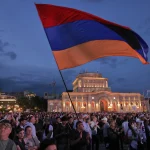
In this reading, the draft constitution is not an act of surrender, but a calculated survival strategy designed to neutralize Baku’s primary pretext for aggression, secure internationally recognized borders, and open economic lifelines. Proponents emphasize that a signed peace treaty could unlock vital regional connectivity, including the U.S.-backed Trump Route for International Peace and Prosperity transit framework, while accelerating Armenia’s diversification toward the European Union and the United States. They also note that Pashinyan is not imposing the charter by decree. Requiring parliamentary approval to call a referendum and promising to resign if the public votes no, the prime minister has placed the ultimate verdict directly in the hands of Armenian citizens.
Ultimately, both sides are grappling with the same agonizing reality: Armenia is navigating an international system governed by energy interests, shifting great-power bargains, and entrenched Washington and Brussels lobbies rather than international law. Critics are right to insist that peace without justice or enforceable guarantees is fragile, and that a democracy must never hollow out its institutions in the name of expediency. At the same time, supporters are right to warn that statesmanship requires confronting the balance of power as it actually exists, rather than risking another devastating war over constitutional text. Whether Armenia’s voters view this charter as a pragmatic shield for their future or an erasure of their past will define the republic for generations to come.